Jan. 15, 2023
Trading With Microsoft Excel Spreadsheets
We have all heard the phrase “The Trend is your friend.” Or, “follow the Trend”. And we all know that, as Chick Goslin said so well in his books, “Continuation is more likely than change.” (Which means that Trends tend to continue longer than we think they will.)
So, which trend do you prefer to trade? Long Term Trend? Medium Term Trend? Or, Short Term Trend? “Long” or “Medium”, or “Short” mean different time frames to each and every different trader, right?
With our approach, using 35 minute price data on Excel spreadsheets, we have over time been able to finely tune our Trend Trading. And not with moving average lines!
For example, here is a very recent short term chart, showing Our Trend Strength Dots: Below you can see our chart of 6 days of Trading activity (Jan 6 thru Jan 13, 2023). The yellow “cross mark” is an End-Of-Day close mark. There are NO EXITS shown, because the neutral momentum areas are usually very good exit areas (or areas to add-on contracts if the conditions are right).
Green dots are Bullish trend strength. Red dots are Bearish trend strength. And blue dots are “neutral” areas of little or no trend inclination.
These red and pink lines are NOT standard moving averages….read on to find out….and see how they can be useful as EXIT signals if wanted.
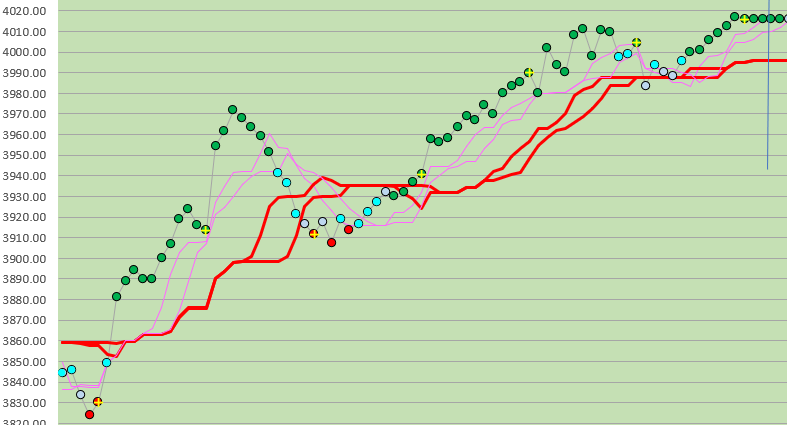
We Trade in a Long direction if the close is above the Red Lines, and use the Pink lines to exit when prices goes down between or below them. We Trade in a Short direction if price is below the Red Lines, and then use the Pink Lines to Exit when prices reverse up and between or above them.
Explanation of the various Trend Lines (not moving average lines):
RED LINES are the Medium Term Trend demarcation. Above the red lines is Medium Term Trend LONG. Below the red lines is Medium Term Trend SHORT.
RED LINES ARE MP17 and the MP21 (using the Ichimoku calculation technique). For the MP17, the calculation is done like this: You take the Highest High in 17 bars and add it to the Lowest Low in 17 bars. Then divide by 2. The results of this calculation gives you the MP17 red line. Please note: This is not the same as the moving average of median price. And it is certainly not the same as a standard simple moving average (nor a standard exponential moving average).
For the MP21: You take the Highest High in 21 bars and add it to the Lowest Low in 21 bars, and then divide by 2. The result gives you the MP21.
THE PINK LINES are the Short Term Trend lines. Above the Pink Lines is Short Term Trend Long. Below the pink lines is Short Term Trend Short.
PINK LINES are the MP6 and the MP9 (again, using the Ichimoku calculation technique). Do exactly as you did with the MP17 and MP21 calculations, but use 6 and 9 as your focus instead of 17 and 21.
These lines have unique properties and reveal the movement of prices much differently than any moving average line. You may grow to like them as we have!
The Trend Strength dots are Green (Bullish momentum), Blue (Neutral momentum), or Red (Bearish Momentum). Bright Blue dots signify strong neutral momentum status.
CHOOSE TO TRADE above and below the Pink Lines for Short Term Trading. This is fast (with new price data each 35 minutes, and subject to occasional whip-sawing of price data).
CHOOSE TO TRADE above and below the RED LINES for Medium Term Trading. This is not so fast, and every once in a while is subject to whip-sawing of prices.
Other Lines: LONG TERM TREND LINES for our style of trading include the MP84 line (for filtering trades according to whether the emini S&P is above or below the MP84 line). This is not shown in the chart. You would trade the pink lines or Red Lines based upon whether they were above the MP84 line.
For us, another good long term Trend line is the Ichimoku SPAN A line (which is not shown), greatly helping with accuracy of trades, and reducing frequency of losing trades.
Using Microsoft Excel for technical analysis is profitable! Try the above mentioned studies with your own Excel spreadsheets!
Good luck with your trading!
 eminiways